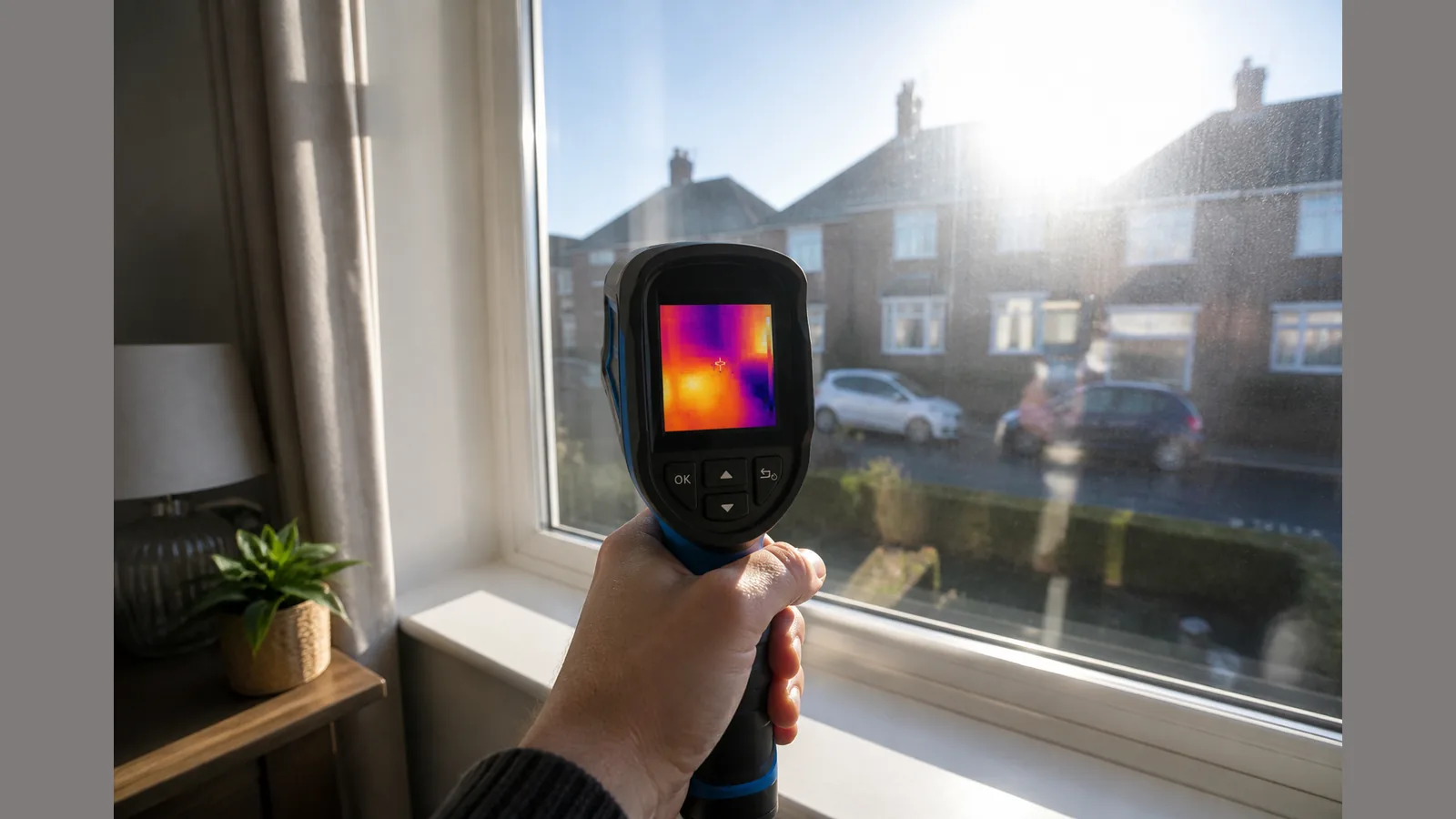
Common mistakes using thermal camera UK: UK Practical Guide
Common mistakes using thermal camera UK usually stem from poor scanning conditions, misreading temperature patterns, or expecting an infrared camera to reveal things it cannot—so incorrect conclusions can follow even when a handheld thermal imager is working as intended.
Symptom → likely cause
When a thermal imaging camera shows unexpected hot or cold patches, the symptom is rarely “the camera is broken”. More often the cause sits in how the scan was set up or how the image was read.
- Blurry or inconsistent patterns: scanning too quickly, standing too far away, or moving while the frame settles.
- Dramatic colour that looks like a fault: reflective surfaces, draughts, recent heating or cooling, or sun-warmed façades creating misleading contrast.
- Cold or hot spots that “must” be a defect: not every temperature difference is a problem—interpretation takes practice, and wet areas, air leaks, missing insulation or similar issues are easy to over-call without context.
- Beautiful images that still mean little: surveys done in unsuitable conditions can look polished while telling you almost nothing useful about the building.
In short, many common mistakes using a thermal camera come down to conditions, pattern interpretation, or asking the tool to show something outside its role.
Safe stop criteria
Pause the scan—and do not treat the image as a firm diagnosis—when any of the following apply:
- You cannot keep a steady view of the area you care about.
- Surfaces have just been heated, cooled, washed, or heavily sunlit, so patterns may still be changing.
- You are relying on colour alone without a clear sense of what “normal” looks like for that material and room.
- The finding would drive irreversible work (opening walls, major repairs) and you have no second check planned.
- You expected the camera to see through solid materials or to prove a specific fault it cannot confirm on its own.
Stopping early is safer than forcing a conclusion from a misleading frame.
What users can check
Before you treat a hot or cold patch as a defect, work through a short checklist:
- Conditions: Is the space reasonably stable? Avoid rushing after heating cycles, weather swings, or strong solar gain on the surface you are viewing.
- Viewpoint: Can you approach closer and re-scan the same spot from a steadier angle?
- Context: Compare like with like—same wall type, similar exposure, neighbouring rooms—rather than judging a single colourful patch in isolation.
- Non-problem differences: Remember that not all cold or hot spots indicate wetness, leaks, pests, mould risk, or missing insulation; many are ordinary thermal variation.
- Repeatability: Does the same pattern appear on a second pass, or does it vanish when conditions or angle change?
These checks help you avoid the classic trap of reading every anomaly as a fault.
When to get support
Seek qualified help when the decision has safety, moisture, or structural implications, or when your images keep disagreeing with what you can see and feel on site. A worthless survey is often one that prioritises striking pictures over sound method—so if you are paying for interpretation, look for clear practice rather than colour alone.
Support is also appropriate if you are unsure whether the camera settings, distance, or environment are suitable for the question you are asking. A handheld thermal imager is a decision aid, not a substitute for building investigation where risk is high.
Next step
If you are choosing a compact infrared camera for careful, methodical checks at home or on light site work, review the TOPDON TC004 Mini handheld thermal camera details and match the tool to steady scanning habits rather than one-shot “diagnosis” shots.
FAQ
Why do thermal images sometimes look dramatic but prove nothing?
Poor conditions and over-interpretation can produce striking colour maps that do not support a reliable conclusion. Good practice matters more than a pretty frame.
Are all cold or hot spots problems?
No. Learning to interpret thermal images takes practice, and many temperature differences are normal rather than signs of leaks, air paths, moisture, pests, or missing insulation.
Can a thermal imaging camera confirm every fault on its own?
No. Common mistakes include expecting the camera to show things it cannot. Use it to guide further checking, not as the sole proof for high-stakes decisions.
What should I do after I spot an odd pattern?
Re-check conditions, repeat the scan, compare similar surfaces, and stop if you would otherwise act on an unverified reading. Escalate when safety or fabric risk is involved.